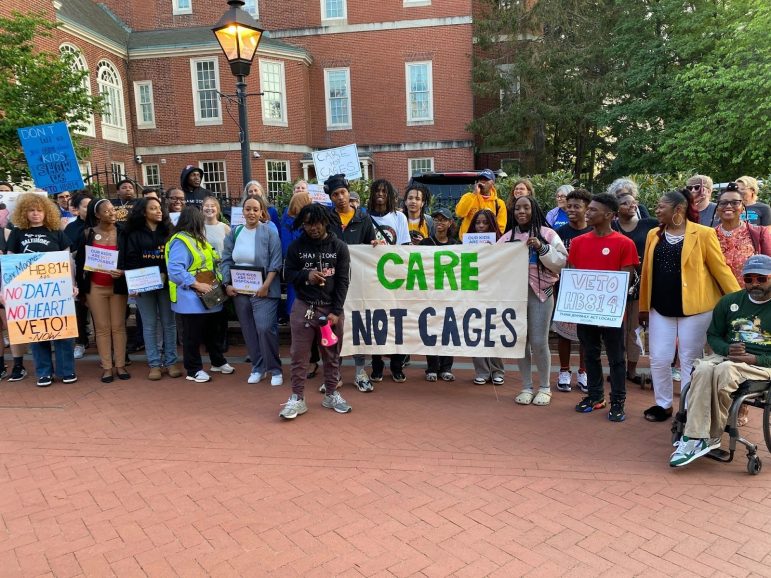
See below for JUFJer Stacy Markowitz’s written testimony to the Maryland General Assembly on the Youth Charging Reform Act.
My name is Stacy Markowitz. I am a resident of District 3. I am a retired educator and school counselor. I worked as a teacher for 19 years and a school counselor for six years in predominantly high needs diverse schools at the middle school level. Since retiring, I have participated in long term counseling sub positions in only high needs schools at the middle school and high school levels. I love working with adolescents. I love being there to support their social and emotional well-being. I have worked hard to become trauma informed and be a restorative practitioner so that I can best support all my kids, but especially those who struggle the most and carry heavy suitcases every day. I am a trained mediator and circle keeper.
I am submitting this testimony on behalf of Jews United for Justice (JUFJ) in support of HB0409, the Youth Charging Reform Act. JUFJ organizes over 6,000 Jews and allies from across Maryland in support of social, racial, and economic justice campaigns at the state and local levels. JUFJ, along with our partners in the Maryland Youth Justice Coalition, have been advocating for years for a complete end to the harmful practice of automatically charging youth as adults. While HB0409 does not end this practice entirely, it takes a much needed step in moving Maryland in the right direction.
Two beliefs I have, among many, that brought me to work with children from my first year as an elementary teacher to today as a retired educator and school counselor are the need for action and the need to make the world a better place than the one into which I was born. The statements below capture those beliefs for me.
“If a person sits in their home and says to themselves,
‘What have the affairs of society to do with me?… Why
Should I trouble myself with the people’s voices of
protest? Let my soul dwell in peace!‘ – If one does this,
they overthrow the world.”
(Midrash Tanhuma, Mishpatim 2:1)
From the concluding paragraph of the Aleinu prayer comes this interpretation: Let the time not be distant, O God, when all shall turn to You in love, when the brokenness in our world is repaired by the work of our hands and our hearts, inspired by Your words of Torah.
I am a counselor and restorative practitioner who is always learning. In my faith, I believe deeply in Tikkun Olam. In our time, this phrase has come to mean making the world a better place through action and activism. For me, Tikkun Olam moves me to work on making the world a better place for our children. For it is our children who represent our futures. If we help them make healthy changes in their lives, they can minimize or stop the passing of generational trauma, which will support them to make different choices in their lives that are not dysfunctional. Those healthy choices, in turn, will lead to our youth becoming successful, productive members of our society who have children who will also be successful, productive members of our society, and so on. As a teacher and school counselor, I have seen too many times the children who come to school with heavy suitcases of trauma due to physical, sexual, and/or verbal abuse. These experiences often result in trauma responses of flight, fight, freeze, or fawning. These trauma responses often lead to maladaptive behaviors, some of which lead to children’s involvement in the juvenile justice system. In my experience, it is often the trauma sensitive children who become involved in the juvenile justice system, and with the way the law stands now, the adult system. Underneath all that trauma and trauma responses are children who never had their basic needs met, and they lack the skills to function in healthy adaptive ways. Many of these kids are our black and brown kids, who are disproportionately represented in the school to prison pipeline and the juvenile and adult justice systems. When youth are automatically moved to adult courts and facilities based on their crimes, we can lose the ability to reach them with alternative means, such as family therapy, group therapy, individual therapy, and aggression replacement training. We also often take away the opportunity for them to repair the harm directly with the one(s) who were harmed. This is an important learning experience that can help change their lives by giving our youth the opportunity to make the world a better place based on what they have learned about themselves and their impact on others. This is not to say that can’t happen in adult prisons, but it is far more rare. We must reach our children while they are still children and provide the resources for them they never had.
Automatically charging adolescents as adults takes away these opportunities and resources to heal and to change. Instead, it reinforces for our youth that they are expendable and not worth saving. They already have poor self-worth and see little future for themselves, which is part of why they are committing crimes. Let’s not compound those issues with automatically charging them as adults.
On behalf of JUFJ, I urge you, in the strongest terms, to pass HB0409 and give our youth a chance to take advantage of the resources to turn their lives around and make our world a better place, as Tikkun Olam tells us we must.