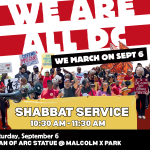
Listen to Rabbi Miriam’s Dvar Torah during our Shabbat Service on Saturday, September 6.
Welcome + Elul
Almost a year ago I was reading a book with my now four year old daughter and in the book, there was a rabbi. And I said to her, Amalia, do you know anyone who is a rabbi? And she looked at me and thought for a minute and said, Rabbi Aaron, who is a rabbi she knows. And I said, well, you know Amalia, I’m a rabbi too. And she looked at me and said, No you’re not, you don’t blow the shofar.
And while it’s true that I in fact don’t blow the shofar, I’m Rabbi Miriam Liebman. I’m the rabbi in residence at JUFJ and I’m here with Rabbi Aaron Potek of Sixth and I and we’re so grateful to also have Micah Hendler here with us to help out with the music and Becca Tannen leading davening.
We just sang a niggun, a wordless melody, called the Elul Niggun. We’re in the Hebrew month of Elul right now — the month that leads up to the High Holidays. It’s a month of prayer and reflection and forgiveness. And to my daughter’s delight, it’s also the month of the shofar —- the ultimate call to action.
We like to joke that as Jews we’re wordy people. We like to talk. And talk. And in just a minute we’re also going to read words from the siddur that we may find meaningful or that we may find meaningless or maybe even somewhere in between. And on the High Holidays especially we say words, and more words, and then some more words. But the height of the service, the peak, the climax, is the shofar. It’s a sound without words.
We can’t blow the shofar today because today is different, today is Shabbat. So instead, we’re going to use our voices to wake us up; we’re going to use our voices to call us to action. And sometimes, the best way to do that is also without words. And so, we’ll carry the Elul Niggun, this wordless song that we just sang, this reminder of the month of Elul, with us, throughout our service today.
Dvar Torah + Charge
Rabbi Meir had a problem: there were neighborhood thugs. So what did he do? He prayed for them to die. If they died, he thought, his problem would go away. If they died, there would no longer be neighborhood thugs bothering him.
His wife, Bruriah, overhears him and, quoting Psalms, says to him,
“יִתַּמּוּ חַטָּאִים מִן-הָאָרֶץ, וּרְשָׁעִים עוֹד אֵינָם
Let sins be uprooted from the earth and the wicked will be no more.”
It doesn’t say חוטאים “Let חוטאים (sinners) be uprooted,” Bruriah says, It says “Let חטאים — their sins — be uprooted.”
Sure, the thugs are annoying, they aren’t great, but don’t pray for them to die, pray for their sins to die. That, she says, is how you do away with evil.
This week’s Torah portion ends with one of the strangest commandments we get:
“You shall blot out the memory of Amalek from under heaven. Do not forget!”
Amalek — the eternal enemy of the Israelites. Blot out their memory. Make it so they are no more and can never again rise up against us. Utterly destroy them.
The disturbing consequence of this command, of course, is that on its face we are being asked to obliterate an entire people. To blot them out.
There’s commentary after commentary asking who is Amalek? Where is Amalek?
But I want to offer this instead — it’s not who and not where but what. What is Amalek? What is it exactly that we are trying to destroy? To blot out?
In the words of Bruriah, “Don’t uproot the sinners, uproot the sins.” We don’t want to destroy our enemies themselves, we want to destroy their ideology.
The hateful, spiteful ideology of this administration that has chosen to take over our city: that is Amalek. And that is something we have the power to blot out.
So folks, let’s blot out any ideology that claims that our neighbors are not welcome here and that my safety is dependent on an armed military force and illegal deportations and disappearances.
Let’s blot out any ideology that would have you believe that being poor or unhoused is a crime.
Let’s blot out any ideology that says that the mere fact of being young and Black is a punishable offense.
“You shall blot out the memory of Amalek from under heaven. Do not forget!”
Folks, take a look around you. This isn’t a city of crime and of fear. Washington, DC, our nation’s capital, is a city of love and joy and community and history. This city is the heart of our nation.
And don’t you forget that. Don’t forget for one second who we are and what we stand for. Don’t forget that power is built through relationships and care. Do not forget that we are here today not to uproot the sinners but we’re here to uproot the sin.
We say that Shabbat is a taste of the world to come, the closest we can get in this life to perfection. Let’s use this Shabbat to give ourselves a vision of what that could look like – a world where we truly do blot out an ideology of hate.
Shabbat shalom.